
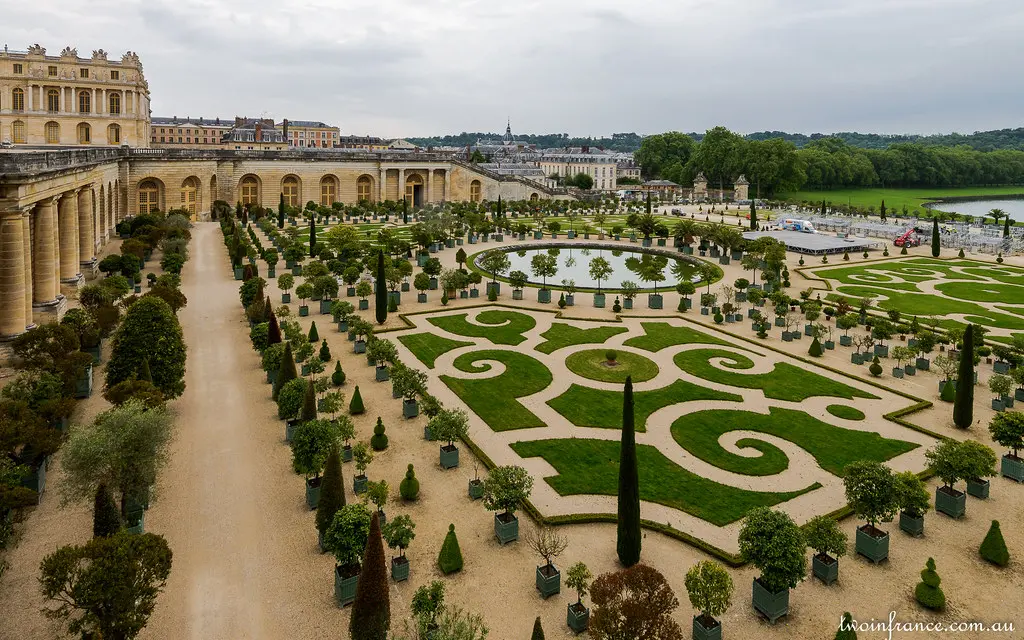
The Versailles Gardens
Versailles is one of the most visited sites in France, with several million visitors each year. Both tourists and locals come to the gardens to experience the serenity and beauty it offers.
The gardens and the Château were inscribed on the UNESCO world heritage list in 1979 and are today seen as one of the icons of France.

In 1649, Versailles was a mere hunting lodge on the top of a windswept hill surrounded by forests and marshland. This is the landscape where a child known as the Rising Sun used to come hunting with his father, Louis XIII.
Half a century later, it had become the most splendid royal palace in Europe.
Linking the two is the story of a young and visionary king who combined political willpower with a very discerning taste for the arts and who employed the greatest artists of his time.
In 1661, Louis XIV commissioned André Le Nôtre to design and construct the gardens of Versailles that, in his view, were just as important as the Château. The works were undertaken at the same time as those for the palace and took forty years to complete.
The laying out of the gardens required enormous work. Vast amounts of earth had to be shifted to lay out the flower beds, the Orangerie, the fountains and the Canal, where previously only woods, grasslands and marshes were.
The earth was transported in wheelbarrows; the trees were conveyed by cart from all the provinces of France, and thousands of men, sometimes whole regiments, took part in this vast enterprise.
With André Le Nôtre, the parks and gardens were extended and structured on the scale of the domain. He used elements that previously existed, but he transformed them completely: the terraces were enlarged, the parterres lengthened, and the groves created. Avenues and walkways stretched further than ever.
2013 was the 400th anniversary of the birth of Andre Le Nôtre, and the Château prepared an excellent multimedia exhibition, the Exhibition Le Nôtre, to celebrate the Année de Nôtre.
Information
Place d’Armes – 78000 Versailles
+33 1 30 83 78 00
The Château de Versailles Palace is open Tuesday to Sunday from 9 am. The last admission to the palace is at 5 pm during the low season and 6 pm during the high season.
The Gardens at Versailles are open every day from 8 am to 6 pm during the low season and 8:30 pm during the high season.
The park is open every day from 7 am to 8:30 pm (7 pm for vehicles) during the summer season and 8 am to 6 pm during the winter season.
The Trianon Palaces are open Tuesday to Sunday during the high season afternoons only from noon to 7 pm (6 pm for buildings).
During the low season (noon to 5 pm), some smaller buildings and parts of the gardens are not open.
From Paris: RER C to Gare Versailles Rive Gauche. (10 minutes to the Palace).
SNCF trains from Gare Saint Lazare arrive at Gare Versailles Rive Droite. (17 minutes to the Palace).
SNCF trains from Gare Montparnasse arrive at Gare Versailles Chantiers (18 minutes to the Palace)
Château Versailles
Gallery



OK… I know that I am gushing, but I love your site. I want our site to look like yours when it grows up. I have spent way to much time reading it this afternoon. So glad we are headed back again this summer! Cheers!